
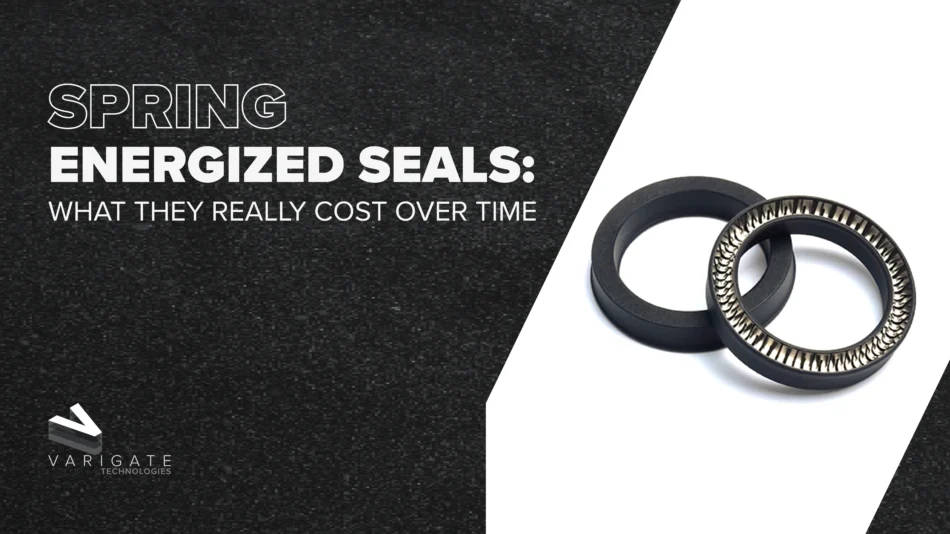
Spring energized seals cost more than standard O rings. Engineers and procurement teams evaluating seal options often stop at the sticker price, but the real comparison is what happens over the life of the equipment.
A seal that fails under pressure or heat does not just need replacing. It can mean unplanned downtime, unscheduled maintenance, and in some cases damage to surrounding components. Spring energized seals are engineered to hold up in conditions where standard seals are more likely to wear out faster, and understanding that tradeoff is what determines value. Varigate Technologies works with engineers to help them weigh that tradeoff for their specific applications.
What Makes Spring Energized Seals Different from Standard Seals?
A spring energized seal pairs a spring with a surrounding jacket, most often PTFE. That spring applies constant outward force, pressing the jacket against the sealing surfaces even as pressure, temperature, or wear conditions shift. Standard O rings rely on the elasticity of a single material to hold that seal. That works well within a defined range, but there is less capacity to adjust once conditions push past it. This added engineering is what allows spring energized seals maintain consistent contact force across a wider range of pressures and temperatures, in applications where a standard seal might start losing its seating force over time.
Why Is the Upfront Cost of Spring Energized Seals Higher Than Standard O Rings?
Spring energized seals cost more upfront because they are more complex to engineer and manufacture. Instead of a single elastomeric component, they involve two parts, a spring and a jacket, that need to be matched precisely to each other and to the application's pressure, temperature, and chemical exposure requirements. Material selection plays a bigger role too, since PTFE jackets come in different formulations depending on what the seal needs to withstand. Standard O rings are simpler by design, which keeps their production cost lower and makes them a reliable, cost-effective choice for a wide range of applications that do not require the additional engineering. The price difference reflects what goes into building a seal for more demanding conditions.
How Do Spring Energized Seals Reduce Downtime and Maintenance Costs?
The value of a spring energized seal shows up over time, not on day one. Because the spring maintains consistent sealing force even as conditions fluctuate, these seals tend to hold their performance longer in demanding environments, which translates directly into fewer disruptions to operations.
That advantage shows up in several practical ways:
- Fewer unplanned shutdowns, since consistent sealing force reduces the likelihood of sudden failure under pressure or heat swings.
- Longer intervals between seal replacements, which means less frequent equipment teardown for maintenance.
- Reduced risk of secondary damage, since a failed seal can sometimes lead to contamination or damage in surrounding components.
- More predictable maintenance planning, since seal life expectancy is more consistent across varying operating conditions.
How Do You Know If Your Application Warrants the Investment?
Determining whether a spring energized seal is the right specification comes down to how demanding the operating conditions are. The investment tends to pay off when standard seals are pushed closer to their performance limits.
The following questions help clarify where a given application falls:
- Does the application involve high pressure cycling, extreme temperatures, or exposure to aggressive chemicals?
- Would a seal failure result in significant downtime, safety risk, or costly damage to surrounding equipment?
- Is the equipment difficult or expensive to access for maintenance, making longer seal life more valuable?
- Does the application require consistent sealing performance across a wide or fluctuating range of conditions?
When Does the Total Cost of Ownership Favour Spring Energized Seals?
Total cost of ownership accounts for more than the price on a purchase order. It includes maintenance labour, equipment downtime, replacement frequency, and the cost of any secondary damage caused by a seal failure. In applications with demanding conditions, these factors accumulate quickly. A standard O ring that needs replacing every few months in a high-pressure environment may end up costing more over a year than a spring energized seal with a longer service interval, once labour and downtime are factored in. The calculation shifts based on how critical the equipment is and how disruptive a failure would be. For applications where reliability directly affects operational continuity, the total cost of ownership often favours the seal with the longer, more consistent service life.
Find the Right Seal for Your Application
The right sealing solution depends on the specific demands of your equipment and operating environment. Varigate Technologies works with engineers and procurement teams to help identify the best fit, backed by real technical depth rather than guesswork. Contact Varigate Technologies or request a quote to get started.