
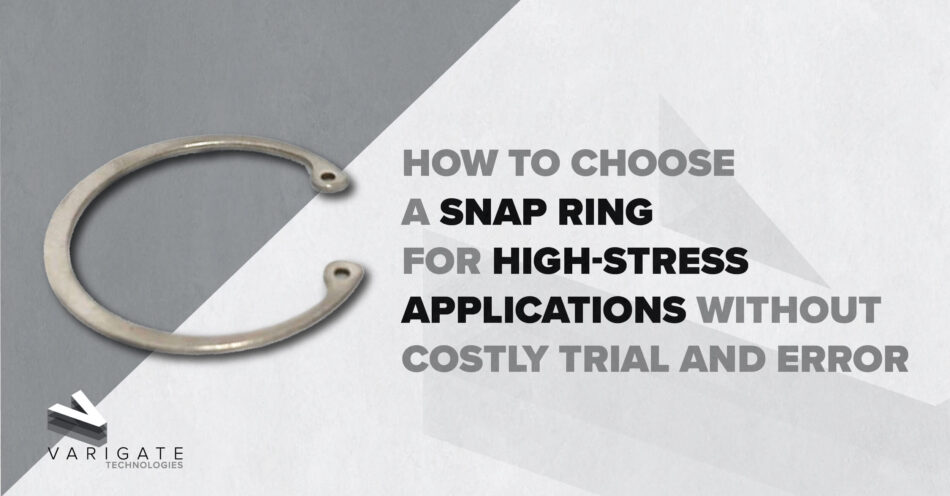
Snap rings do not get nearly enough credit. They are a small, simple component that holds an assembly together through heavy loads, constant vibration, and extreme conditions, without batteries, wiring, or maintenance. When the right snap ring is chosen, they are one of the most reliable and cost-effective solutions in industrial engineering. However, High stress environments place specific demands on every component in an assembly, and snap rings are no exception.
What makes a snap ring reliable in high-stress environments?
The conditions inside heavy industrial equipment are unforgiving. A snap ring that performs well in a controlled setting can behave very differently when all three are working against it at once.
A snap ring in these environments needs to meet a specific set of demands:
- Temperature resistance: Thermal cycling causes materials to expand and contract. A snap ring needs to maintain its seating force through those changes without relaxing or shifting.
- Vibration tolerance: Constant lateral movement can work a ring loose over time. The right ring holds its position even when the surrounding assembly is in motion.
- Load capacity: Heavy dynamic loads apply force in multiple directions at once. A ring that cannot handle the load range of the application will deform or unseat under pressure.
- Groove compatibility: Even a well-chosen ring will underperform if the groove dimensions are off. Fit and finish matter as much as the ring itself.
What do high-stress environments demand from a snap ring?
High stress environments are defined by how little tolerance they leave for an underspecified component. Heat weakens holding force. Vibration works against seating. Heavy loads test the limits of the material. None of these happen in isolation, which is why the right snap ring choice in a demanding application is rarely obvious and worth thinking through carefully.
Why does snap ring selection matter more in demanding applications?
In a standard application, an imperfect snap ring specification can be forgiving. The conditions are stable enough that the ring holds up even if it was not the ideal choice. High stress environments remove that margin entirely. When different factors are present, a ring that is slightly underspecified for the application will eventually make itself known, usually at the worst possible time. Replacing a snap ring is inexpensive. Replacing the components that fail because of it is not.
What separates a snap ring that holds from one that does not?
Most snap ring specifications focus on the obvious: load rating, ring type, and basic dimensions. Those matter, but they do not tell the whole story. In more extreme applications, the factors that determine long term reliability tend to be the ones that get the least attention during the selection process. Three of them come up repeatedly:
- Spring back force: Spring back force is how well a ring returns to its seated position after load is applied and released. In high cycle applications, a ring that loses spring back force gradually will allow micro movement at the groove interface long before any visible sign of wear appears.
- Surface coating: An uncoated ring in a corrosive or high moisture environment will degrade at the groove interface over time, quietly reducing its effectiveness without obvious warning signs.
- Groove finish: A rough or poorly machined groove creates uneven contact along the ring's edge, which concentrates stress at specific points rather than distributing it evenly. Even a well-chosen ring cannot compensate for that inconsistency over an extended service life.
Not Sure Where to Start? Varigate Technologies Can Help!
Snap ring selection gets a lot easier when you are working with a team that understands the technical side of the conversation. Varigate Technologies works directly with engineers and procurement specialists to identify the right components for the application, not just the closest available option. The goal is always a specification that performs reliably in real operating conditions. Contact Varigate Technologies today or request a quote to get started.