
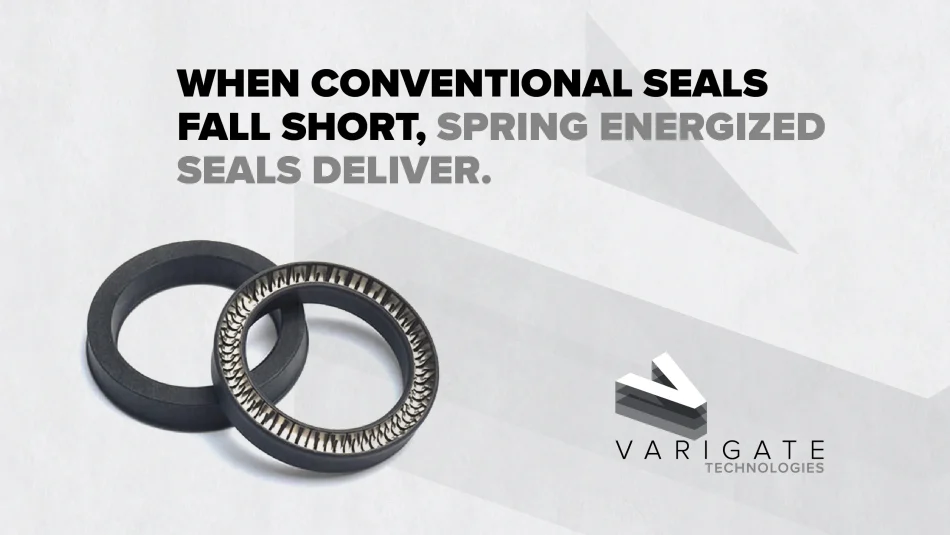
What Are Spring Energized Seals and How Do They Work?
Key Components of a Spring Energized Seal
Spring energized seals are constructed from a precisely integrated set of components. They are designed to provide controlled sealing force and consistent performance across a wide operating range.
- Polymer Jacket: The outer jacket forms the primary sealing interface and is typically manufactured from PTFE or other high-performance polymers. These materials offer low friction, broad chemical compatibility, and excellent dimensional stability, enabling smooth operation against metal surfaces.
- Energizing Spring: The metal spring provides a continuous, controlled radial load that maintains consistent contact with the sealing surface. This mechanical energization allows the seal to perform reliably across pressure fluctuations and low-pressure conditions.
- Spring Cavity: The spring cavity is precisely engineered to support uniform load distribution and spring response. Proper cavity design allows the spring to flex freely without binding, helping preserve sealing integrity over time.
- Seal Geometry: The seal, including components such as the sealing lips and contact surfaces, is designed for specific hardware configurations and motion requirements. Geometry directly influences sealing efficiency, wear behaviour, and installation reliability.
Why Spring Energized Seals Excel in Demanding Environments
Spring energized seals perform reliably in demanding environments because their sealing force is mechanically maintained, rather than dependent on system pressure. This allows stable performance during start-up, shutdown, and low-pressure conditions where traditional seals often lose effectiveness.
That mechanical consistency is reinforced by high-performance materials such as PTFE, which provide low friction, chemical resistance, and thermal stability. Together, the spring and polymer materials enable spring energized seals to withstand extreme temperatures, aggressive media, and dynamic movement while maintaining dependable sealing performance over time.
Industrial Applications for Spring Energized Seals
Spring energized seals are commonly used in applications where operating conditions exceed the capabilities of conventional sealing solutions. Their ability to perform consistently across a wide range of pressures and temperatures makes them suitable for many demanding industrial environments.
- Oil and Gas Equipment: In upstream, midstream, and downstream operations, spring energized seals are commonly specified for valves, pumps, and downhole tools exposed to high pressures and temperature extremes. Their reliability supports long service intervals in environments where equipment access and maintenance opportunities are limited.
- Chemical Processing: Chemical processing systems often require sealing solutions that can withstand corrosive materials, while maintaining consistent performance over extended operating cycles. Spring energized seals are applied in these environments to support safe, predictable operation in both continuous and batch processing applications.
- Aerospace and Defence: Aerospace and defence systems rely on precision components that must perform under extreme temperatures, vacuum conditions, and dynamic motion. Spring energized seals are selected to support tight tolerances and consistent sealing performance in critical, mission-sensitive equipment.
- Semiconductor and Electronics Manufacturing: In semiconductor and electronics manufacturing, vacuum systems and cleanroom equipment demand low outgassing and strict contamination control. Spring energized seals help protect sensitive processes by maintaining sealing integrity without introducing particulates.
Industrial Hydraulics and Pneumatics: Hydraulic and pneumatic systems operate under fluctuating pressures and repeated motion cycles that challenge conventional seals. Spring energized seals are integrated into cylinders, actuators, and control systems to support smooth operation and reduce leakage over time.