
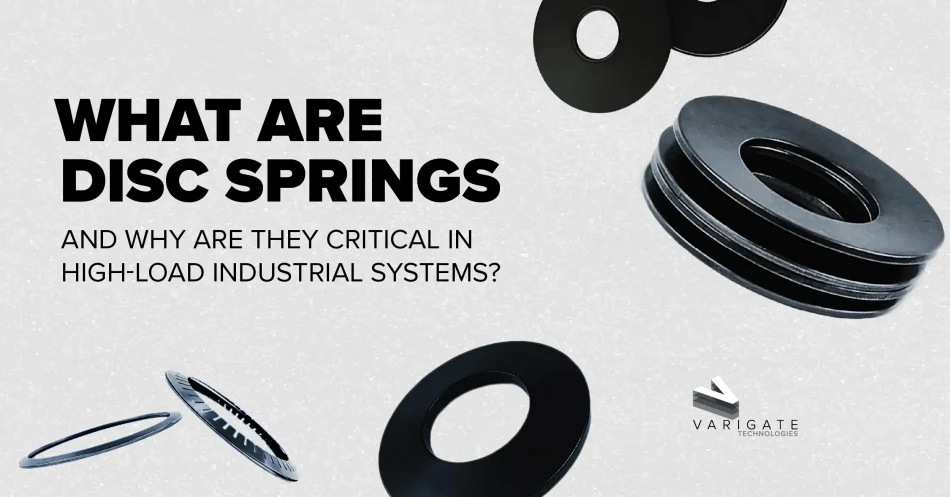
What Are Disc Springs?
How Do Disc Springs Handle Vibration, Shock, and Thermal Changes?
In applications subject to vibration and dynamic loading, disc springs help maintain preload in bolted joints by compensating for movement and settling within the assembly. As external forces act on the joint, the spring deflects in a controlled manner, allowing it to respond to changing conditions without a loss of clamping force. This continuous response helps reduce loosening and wear in connections exposed to ongoing or intermittent vibration.
The controlled deflection allows disc springs to absorb energy when shock loads occur, reducing the transfer of sudden forces to surrounding components. As operating temperatures change, the spring adapts by accommodating thermal expansion and contraction within the assembly, maintaining clamping force as stresses increase. In systems where these operating demands are combined with high applied loads, this ability to sustain force becomes especially important.
What Industries Commonly Use Disc Springs?
Disc springs are used across a wide range of industries where controlled force, compact design, and adaptability are required within mechanical assemblies. Common applications include:
- Manufacturing and Industrial Equipment: Disc springs are used in machinery and tooling to maintain preload, compensate for wear, and support consistent operation in mechanically driven systems.
- Energy and Power Generation: In power generation equipment, disc springs help manage movement and loading in bolted joints and assemblies exposed to fluctuating operating conditions.
- Oil and Gas: Disc springs are applied in valves, flanges, and other critical components where maintaining clamping force is essential in high-pressure environments.
- Mining and Heavy Equipment: Heavy-duty equipment relies on disc springs to support joints and assemblies subjected to repeated loading and harsh operating conditions.
- Transportation and Rail: Disc springs are used in braking systems, suspension-related assemblies, and structural components where space constraints and load control are important.
- Construction and Infrastructure: Disc springs support structural and mechanical assemblies by accommodating movement and maintaining force in applications exposed to changing loads.
What Should You Consider When Selecting a Disc Spring?
What Are the Different Types of Disc Springs, and How Do You Choose the Right One?
Disc springs are available in several designs and material options, each intended to address specific operating conditions. Identifying the right type depends on factors such as temperature, environment, space constraints, and performance requirements.
- DIN 2093 Disc Springs: Choose DIN 2093 disc springs when your application requires standardized dimensions and predictable performance. These springs are well suited for general industrial use where consistency, repeatability, and compatibility with established specifications are important.
- High-Temperature Disc Springs: High-temperature disc springs are the right choice for applications exposed to sustained or fluctuating heat. They are designed to maintain spring characteristics in environments where standard materials may lose strength or experience premature fatigue.
- Wire Segmented Disc Springs: Wire segmented disc springs are typically selected when very high loads, long fatigue life, or limited installation space are primary concerns. Their segmented design allows them to handle demanding load conditions while offering greater flexibility in assembly.
- Corrosion-Resistant Disc Springs: Corrosion-resistant disc springs are best suited for applications exposed to moisture, chemicals, or outdoor conditions. They are commonly used where material degradation could compromise performance or service life.
- Disc Springs for Ball Bearing Applications: Disc springs designed for ball bearing applications are used when precise preload control and compensation for thermal expansion are required. They help maintain consistent bearing performance in rotating equipment and precision assemblies.