
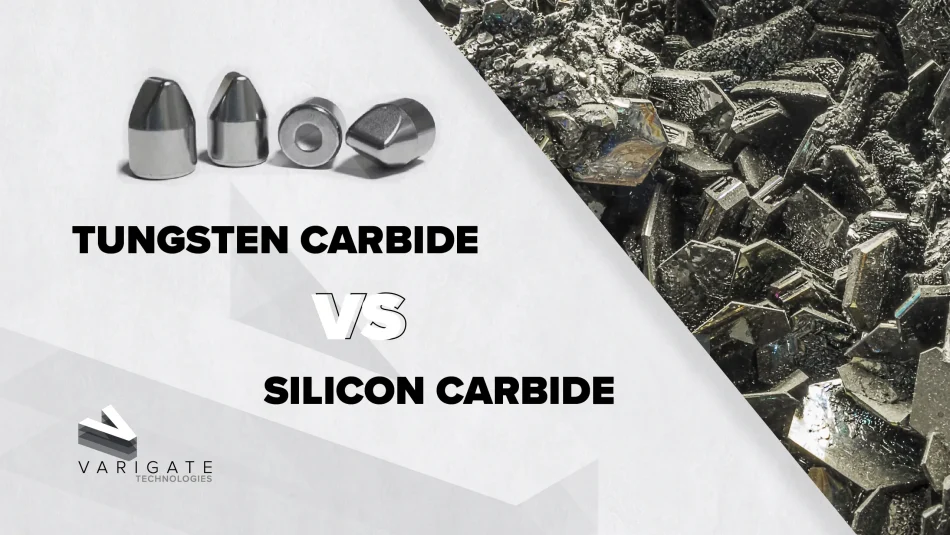
Why Tungsten Carbide and Silicon Carbide Dominate Industrial Applications
Both tungsten carbide and silicon carbide have earned their place as go-to materials in industries where failure isn't an option. Tungsten carbide combines tungsten and carbon to create an exceptionally hard, wear-resistant compound that thrives under extreme abrasion, heavy impacts, and constant friction. Silicon carbide pairs silicon with carbon to produce a ceramic material that excels in high-temperature environments and resists chemical corrosion like few other materials can.
What sets these materials apart is their ability to solve specific, real-world problems across manufacturing, mining, aerospace, electronics, and beyond. The key is understanding what your application truly demands, like maximum impact resistance, thermal stability, or chemical inertness. That's where the comparison between tungsten carbide and silicon carbide becomes critical.
Breaking Down the Properties: How Tungsten Carbide and Silicon Carbide Compare
Understanding the performance differences between tungsten carbide and silicon carbide starts with their core properties. Both materials are incredibly hard, ranking around 9 to 9.5 on the Mohs scale, but they behave differently under stress, heat, and chemical exposure. Tungsten carbide offers exceptional toughness, meaning it can absorb impacts without fracturing, which makes it ideal for applications involving mechanical stress and abrasive wear. It maintains its hardness at elevated temperatures, though prolonged exposure to extreme heat can eventually cause degradation. Tungsten carbide is also significantly heavier, which can be an advantage in applications requiring mass or stability.
Silicon carbide, on the other hand, is just as hard but more brittle. It doesn't handle sudden impacts as well, but it excels where tungsten carbide struggles. Silicon carbide maintains its structural integrity at temperatures exceeding 1,600°C, making it the superior choice for high-heat environments. It's also highly resistant to chemical corrosion and oxidation, and its lightweight nature makes it valuable in applications where weight reduction matters.
Industrial Applications: Where Each Material Performs Best
The real test of any material is how it performs in the field. Tungsten carbide and silicon carbide each shine in different industrial settings and understanding where they excel can help you make a more informed material selection.
Tungsten Carbide Applications:
- Cutting Tools and Machining Inserts: Tungsten carbide maintains sharp edges and withstands high mechanical loads, making it essential for drill bits, end mills, and turning tools that face constant wear.
- Mining and Heavy Machinery: Components exposed to extreme abrasion, such as crusher parts, excavator teeth, and drilling equipment, rely on tungsten carbide for long-term durability.
- Wear Parts: Seals, nozzles, dies, and bushings benefit from tungsten carbide's toughness in high-friction environments where frequent replacement would be costly.
- Metalworking and Industrial Tooling: Its impact resistance and wear performance reduce downtime and improve operational efficiency in stamping, forming, and fabrication processes.
Silicon Carbide Applications:
- Semiconductor Manufacturing: Silicon carbide's thermal conductivity and electrical properties make it critical in electronic component production.
- High-Temperature Equipment: Furnace linings, kiln furniture, and heat exchangers operating above 1,600°C depend on silicon carbide's ability to maintain structural integrity under extreme heat.
- Abrasive Products: Grinding wheels, sandpaper, and polishing compounds use silicon carbide's hardness to deliver effective material removal and surface finishing.
- Aerospace and Automotive Components: Lightweight, high-performance parts like brake discs benefit from silicon carbide's strength-to-weight ratio and thermal stability.
- Chemical Processing Equipment: Silicon carbide resists corrosion in harsh chemical environments, making it valuable in pumps, valves, and reactor components.