
An Overview of Belleville Washers
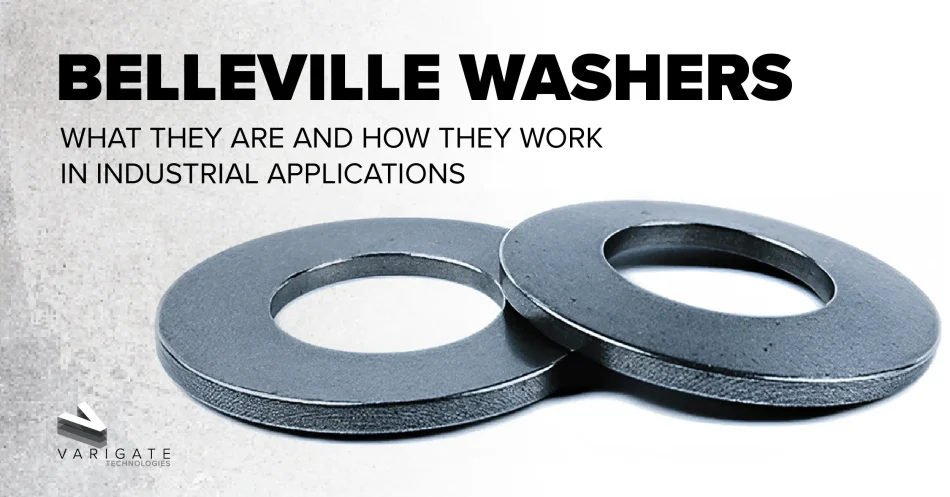
A Belleville washer is a conical disc spring designed to deliver strong axial force in a compact form. Unlike flat washers, which simply distribute load, its tapered shape allows it to flex under pressure and maintain consistent tension within a joint.
Varigate Technologies offers Belleville washers manufactured from high-temperature alloys such as Inconel 718, Inconel 750, and Nimonic 90, making them suitable for environments that demand stability under extreme heat and repeated loading. This combination of efficient geometry and durable materials makes Belleville washers a dependable choice for tight spaces and high-performance applications.
How Belleville Washers Manage Load and Maintain Tension
Performance Advantages in High-Demand Environments
Industrial Uses for Belleville Washers
Belleville washers’ ability to deliver strong, consistent clamping force in a compact design makes them practical across many technical environments. Below are some of the most common industrial applications.
- High-Temperature Systems: Used in equipment exposed to extreme heat where standard washers lose strength. High-temperature alloys, such as Inconel or Nimonic, keep the washer stable and prevent joint relaxation.
- Vibration-Heavy Machinery: Belleville washers are Ideal for motors, compressors, pumps, and rotating equipment where vibration can loosen fasteners. The washer’s spring action helps maintain tension over long operating cycles.
- Thermal Cycling Environments: They are beneficial in assemblies that expand and contract with temperature changes. Belleville washers absorb movement and help prevent joint fatigue.
- Pressure Vessels and Flanged Connections: Belleville washers can be used to maintain gasket compression in critical sealing applications. Their predictable load makes it easier to achieve consistent sealing performance.
- Aerospace Components: Belleville Washers are beneficial in systems that require compact, lightweight hardware that is capable of withstanding high loads and demanding environmental conditions.
- Energy and Power-Generation Equipment: They are common in turbines, reactors, and high-pressure systems where joint stability is essential for safety and long service life.
Selecting the Appropriate Belleville Washer
Selecting the right Belleville washer begins with understanding the forces and conditions the joint will experience. Load requirements, available space, expected movement, and operating temperatures all guide the choice. Engineers often review a washer’s load capacity and deflection range first, determining whether a single washer will work or if a stack arrangement is necessary to achieve specific force or flexibility targets.
Material selection is just as important. High-temperature environments or applications exposed to frequent thermal cycling benefit from alloys such as Inconel or Nimonic, which resist relaxation and maintain stable performance. For less demanding conditions, stainless or carbon steel may be suitable. When the washer’s dimensions and material are properly matched to the application, the result is a reliable, long-lasting joint capable of maintaining tension far better than a standard flat washer.